
The framed-vs-frameless decision is the most common one we field on bathroom-mirror jobs in Bergen County. The two options look very different, install very differently, and live in the home very differently — but the price ranges overlap enough that the choice comes down to design preference rather than budget. This guide walks through the comparison head-to-head so you can make the call with confidence.
If you're planning a broader mirror-wall project (full-wall vanity, his-and-hers, ceiling-to-counter), see our complete guide to custom mirror walls in NJ for the larger-scale decisions. For now, we're focused on the single vanity mirror above a typical bathroom sink.
What is a framed vanity mirror?
A framed vanity mirror has a decorative trim around the perimeter of the glass — wood, painted MDF, metal, composite or a metal-and-leather wrap. The frame is assembled around the mirror in the shop or by the framer, and the finished unit ships and installs as a single object: glass, frame, mounting hardware, all together.
Framed mirrors hang on the wall the same way a piece of artwork does. The most common mounting is a French cleat — a wedge-shaped wood or metal bracket attached to the wall, paired with a matching wedge on the back of the frame. The mirror lifts onto the cleat and locks in place under its own weight. D-rings with picture-hanging hardware are an alternative for smaller pieces. Both methods are fully reversible — the mirror comes off the wall in the same minute it took to install.
The frame itself does several visual things. It establishes the mirror as a discrete decorative object (a piece of furniture, almost). It provides a finished edge that can match cabinetry, hardware or tile trim. It allows for a wider range of styling — ornate, traditional, rustic, industrial, minimal modern — than a frameless mirror, because the frame material and finish can vary independently from the glass.
Common frame styles in NJ baths
- Wood, painted. The most common frame material in traditional and transitional baths. Painted white, soft gray, deep navy or matte black, often matching the vanity cabinetry.
- Wood, stained. Walnut, oak, white oak — popular in transitional and modern-organic baths. Often paired with brass or matte black hardware.
- Metal — brushed nickel, brass, matte black. Thin metal frames (1/2-inch to 1-inch reveal) give a clean modern look with a finishing line that ties to plumbing fixtures and hardware.
- Beaded, fluted or decorative. Traditional ornate frames for powder rooms, period homes and statement baths where the mirror itself is meant to be a focal point.
- Antique or vintage frames. Antique frames bought separately and fitted with a custom mirror at the shop — popular in older Bergen County homes where the bath design pulls from the original era of the house.
What is a frameless vanity mirror?
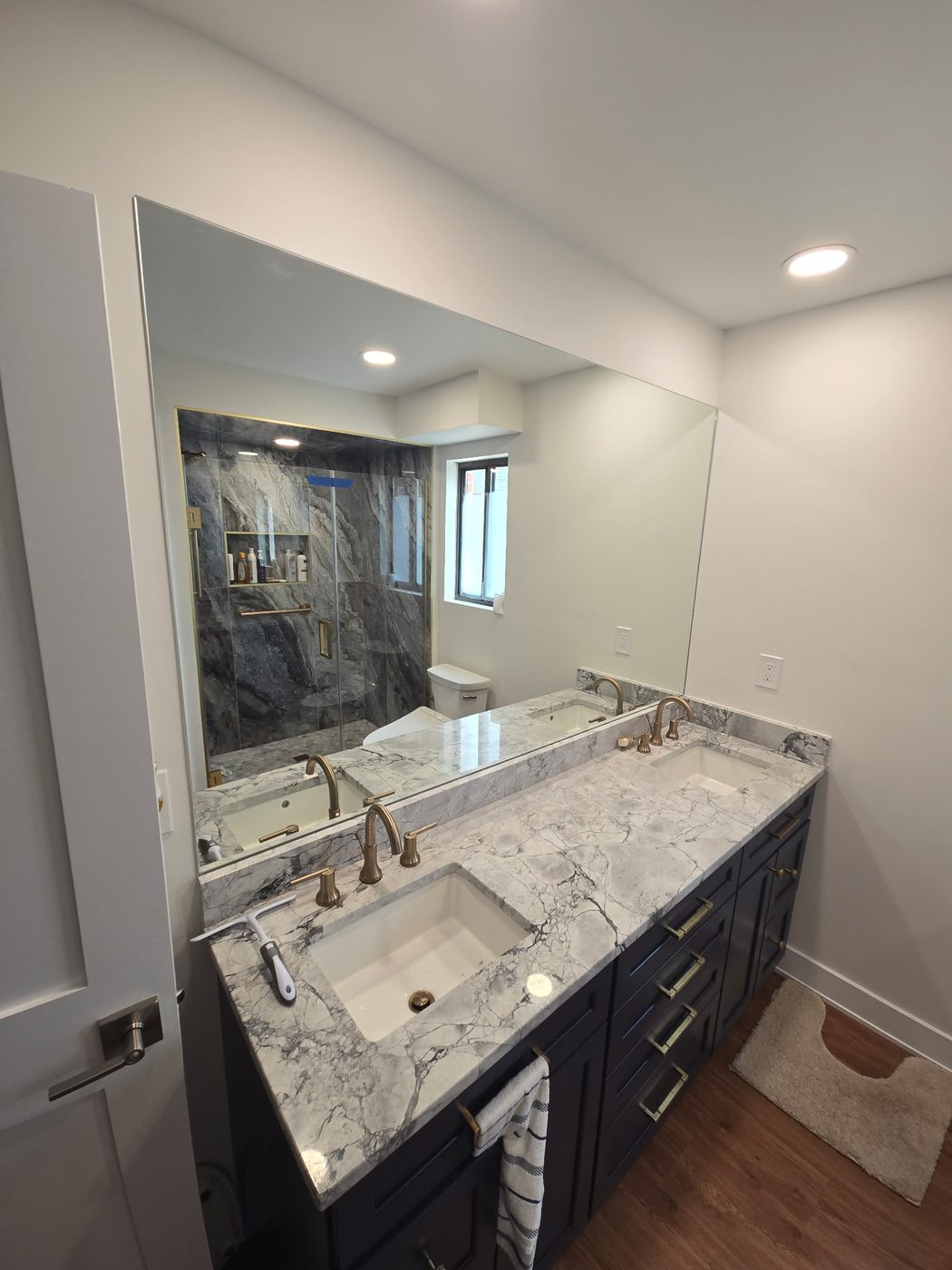
A frameless vanity mirror is just the polished mirror — no trim, no surround. The glass is cut to size, the edges are polished to a finished profile (pencil, flat, beveled or ogee), and the mirror is mounted directly to the wall using mirror mastic and often a bottom J-channel for mechanical redundancy.
Frameless mirrors read as architecture rather than furniture. They become part of the bathroom surface in the same way the tile, the countertop or the paint becomes part of the room — visually integrated, permanent, and largely invisible as a discrete object. The reflection is the design feature, not the mirror itself.
The edge finish does all the visual work on a frameless mirror. A pencil edge produces the cleanest, most modern look — the edge fades into the wall and the mirror becomes a continuous reflective surface. A flat polished edge adds a slight architectural reveal. A beveled edge adds a faceted detail at the perimeter that gives the frameless mirror some of the visual presence of a frame without actually adding one — popular in transitional baths where pure-minimal frameless might feel too austere.
Side-by-side comparison
| Factor | Framed | Frameless |
|---|---|---|
| Visual feel | Decorative, furniture-like, finished | Architectural, minimal, continuous |
| Design context | Traditional, transitional, powder rooms, period homes | Modern, contemporary, new builds, master baths |
| Cost (30″×36″) | $280 – $550 installed | $180 – $320 installed |
| Install method | French cleat or D-rings — reversible | Mirror mastic + J-channel — permanent |
| Install time | 15 – 30 minutes | 45 – 90 minutes |
| Wall prep | Minimal — finds the studs | Clean, sealed, level drywall required |
| Refresh / swap later | Easy — lift off, hang new | Difficult — cut free, patch drywall |
| Sizing flexibility | Limited to frame sizes; can be customized but more lead time | Fully custom to the inch in any rectangle, round, oval or shape |
| Cleaning | Frame collects dust; reach top and bottom | Wipe edge-to-edge in one pass |
| Resale appeal | Buyers can imagine swapping | Buyers see a finished bath; permanent feature |
When framed is the right call
Several situations push the decision toward framed:
Traditional or period bath design. If the bath has clawfoot tubs, beadboard wainscoting, brass fixtures, mosaic tile or any classic-leaning design vocabulary, a framed mirror reads as part of the era. A frameless mirror in a traditional bath can feel like a mismatched modern element bolted onto an otherwise classic room.
Powder rooms. Powder rooms are visual rooms — used briefly, looked at often, often the most strongly themed bath in a house. A framed mirror gives you an extra decorative element to play with. We see ornate gilded frames, antique frames, leather-wrapped frames and dramatic painted frames in Bergen County powder rooms more than anywhere else.
Renters or short-term homeowners. If you don't own the home, or you might sell within a few years, framed is the practical choice. The mirror moves with you or stays as a removable upgrade for the next owner.
Refresh-prone homeowners. If you redecorate every few years, framed lets you swap the mirror as easily as you'd swap a piece of artwork — different frame, different style, different size all become small projects rather than full renovations.
Matching existing cabinetry. If the vanity has a strong color, finish or material identity (deep navy paint, brass detail, walnut veneer), a framed mirror can match or complement it in a way that visually anchors the room. Frameless mirrors disappear visually; framed mirrors pull color and material into the eye-level zone.
When frameless is the right call
The flip side of the decision:
Modern or contemporary design. Clean lines, neutral palette, large-format tile, single-slab counters, integrated sinks — these design vocabularies want frameless. The mirror should be part of the surface, not a separate decorative object.
New construction and gut remodels. If the bathroom is being designed from scratch, frameless is increasingly the default. Builders and designers in 2025 spec frameless for nearly all new-build master baths and most secondary baths.
Large or non-standard sizes. A 60-by-36 mirror over a double vanity, a 48-by-48 square mirror, a custom shape following an arched window — all are easier and cheaper to fabricate frameless. Custom frames at unusual sizes add cost and lead time.
Bright, clean, gallery-like baths. If you want the bath to read as a quiet, luxurious, spa-like space, frameless does that better than any framed option. The mirror becomes a window onto the room's reflection rather than a piece of decor competing for attention.
Maximum visual size. A frameless mirror reads bigger than a framed mirror of the same physical dimensions, because the eye registers the reflective surface as continuous with the wall. In a small bath, frameless makes the room feel larger.
Tip: A frameless mirror with a beveled edge is a useful middle-ground. The beveled edge adds a faceted reveal that catches light around the perimeter — gives the mirror more visual presence than a pure pencil-edge frameless without committing to a literal frame. Popular in transitional baths in older NJ homes.
Cost in detail
Pricing depends on size, edge finish, frame material (if any) and install. Most North Jersey custom vanity mirrors fall between $180 and $850 installed.
Frameless ranges:
- 30″×36″ standard frameless, pencil edge, mastic install: $180 – $320
- 36″×42″ frameless, beveled edge, mastic + J-channel install: $400 – $650
- 60″×36″ double-vanity frameless, pencil edge: $450 – $750
- Low-iron frameless (any size): add 25–35% for the upgrade glass
- Custom shape (arched, circle, oval): add template fee plus 15–25%
Framed ranges:
- 30″×36″ wood-framed, painted, French cleat install: $280 – $550
- 36″×42″ metal-framed (brushed nickel or matte black): $380 – $650
- 30″×36″ antique or decorative frame, custom fit: $400 – $850+
- 60″×36″ wood-framed double vanity: $550 – $900
The cost difference between basic framed and basic frameless is roughly $100 to $250 on a typical single-vanity mirror — meaningful but not huge. The cost difference grows when either spec is upgraded (beveled edge on frameless, decorative trim on framed) and overlaps when both are upgraded.
Install difficulty and reversibility
The install difference is the most underappreciated factor in the decision.
A framed mirror install is fast. We locate the studs, mount the French cleat or D-ring hardware, lift the mirror onto the wall, and check level. 15 to 30 minutes start to finish. The mirror is fully reversible — lift it off the cleat any time, fill the screw holes, you're back to a clean wall.
A frameless mirror install is slower and more involved. We check the wall prep (drywall must be clean, sealed and level), install the J-channel along the bottom, dry-fit the mirror, apply mirror mastic to the back in vertical beads, press the mirror onto the wall, install top clips for redundancy, and tape the mirror in place while the mastic cures over 24 to 48 hours. 45 to 90 minutes on-site, plus the cure time.
The frameless install is also largely permanent. To remove a mastic-installed mirror later, we cut the mirror free with a wire saw (the silver backing comes off with it), remove the residual mastic with a scraper and solvent, and patch the drywall behind. It's doable but it's a project, not a 15-minute swap.
For most homeowners that permanence is the right tradeoff — the mirror is intended to be part of the bath for the long run, and a permanent install is the cleanest possible look. For homeowners who want flexibility, framed is genuinely the better choice on the install dimension alone.
What we recommend by bathroom type
After hundreds of NJ bathroom mirror jobs, here is the pattern we see most often:
- Primary / master bath. Frameless is the default for modern and transitional homes. Framed in traditional homes or when there's a strong cabinetry color or finish to match.
- Secondary baths. Frameless for new builds and modern remodels. Framed for traditional or budget-conscious refreshes.
- Powder rooms. Framed almost every time. The powder room is the most decorative bath in the house and the mirror is part of the decor.
- Kid baths and hall baths. Framed for durability and easy swap as styles change. Frameless if the design intent is permanent.
- Pool baths and outdoor changing rooms. Frameless with a polished pencil edge — easy to clean, no frame to collect moisture and dust.
For our active service offering on custom mirrors of both types, see our mirrors page. For a complementary read on how mirrors work in larger formats, the custom mirror walls complete guide covers the full-wall and architectural side of the category.
Planning a vanity mirror update?
We measure on-site, talk through framed vs frameless with your bath in mind, and quote in writing — most vanity mirrors are fabricated and installed within 7 to 10 business days. Delivery across Bergen, Passaic, Hudson and Essex counties.
Get a Free In-Home Measure
Sizing rules of thumb for both
Independent of the framed-or-frameless choice, the sizing logic for a vanity mirror is similar:
- Width. Match the vanity or sink width. A 30-inch single sink takes a 30-inch wide mirror; a 60-inch double vanity takes a 60-inch wide mirror (one piece) or two 28-inch mirrors with a gap (two pieces). Mirror width shouldn't exceed vanity width.
- Height. 30 to 42 inches tall is the standard range. The mirror should start 4 to 8 inches above the countertop and end 4 to 8 inches below the ceiling, with the centerline at standing eye level for an average adult (roughly 5'7" or 66 inches from the floor).
- Distance from countertop. Leave 4 to 8 inches between the top of the backsplash and the bottom of the mirror. This gives room for toothbrush holders, soap dispensers and the visual breathing room that prevents the mirror from looking like it's sitting on the counter.
- Sconce coordination. If sconces flank the mirror, the mirror width should be narrower than the distance between the sconces (typically 4 to 8 inches narrower on each side). Sconce height is usually centered at 65 to 70 inches from the floor.
Putting it all together
The framed-vs-frameless decision is mostly a question of how you want the bathroom to feel. Frameless gives you a quiet, architectural, modern bath where the mirror disappears into the surface and the room reads as a continuous luxurious space. Framed gives you a finished, decorative, art-on-the-wall feel where the mirror is a visible design element that can match cabinetry, set a mood, or change over time.
Cost overlaps enough that budget isn't the deciding factor for most homeowners. Install difficulty matters mostly if you might want to swap mirrors in the future. Sizing flexibility favors frameless for unusual dimensions. Design context favors framed for traditional rooms and frameless for modern ones.
If you're still torn, the right move is a measure visit — we'll look at your bathroom, the cabinetry, the fixtures and the broader design, and tell you which way the room is leaning. Most homeowners know within 10 minutes of standing in the actual bath which option fits. Call to schedule the measure and we'll bring frame samples and a couple of edge profiles so you can see the difference in your own space.