Quick answer: A custom mirror wall is a single sheet — or seamed run of sheets — of mirror fabricated and installed to fit one specific wall. The category covers bathroom vanity mirrors, home-gym walls, entryway statement walls, closet and dressing-room mirrors, and full bedroom feature walls. It differs from a framed off-the-shelf mirror in that every dimension is field-measured, the edges are finished to your spec (polished, beveled, ogee, or framed), and the mirror mounts flush to the wall rather than hanging off a hook.
This pillar guide covers everything that goes into the decision in North Jersey — applications, sizing, edges, mounting, lighting integration, mirror types, cost, and care. Each section can be read on its own. If you have a specific application already in mind, jump straight to it below.
What counts as a "custom" mirror?
A custom mirror is any mirror that is field-measured and fabricated to the dimensions of one specific opening or wall, rather than purchased in a stock framed size. The defining features are dimensional accuracy (cut to the actual wall, not the nearest standard size), a finished edge (polished, beveled, ogee, or framed) that you choose, and a flush installation method that hides the mounting hardware. Everything from a 24″ × 36″ over-the-vanity mirror to a 16-foot gym wall qualifies as long as it is built to your room.
The opposite of a custom mirror is a stock framed mirror — the type sold in a box at a home center. Those have fixed dimensions, a pre-applied frame, and a wire-and-hook mounting system. A custom mirror is field-measured, edge-finished to your spec, and mounted flush to the wall.
Where custom mirror walls go in a home
Five applications cover the vast majority of residential custom mirror work in North Jersey.
Bathroom vanity
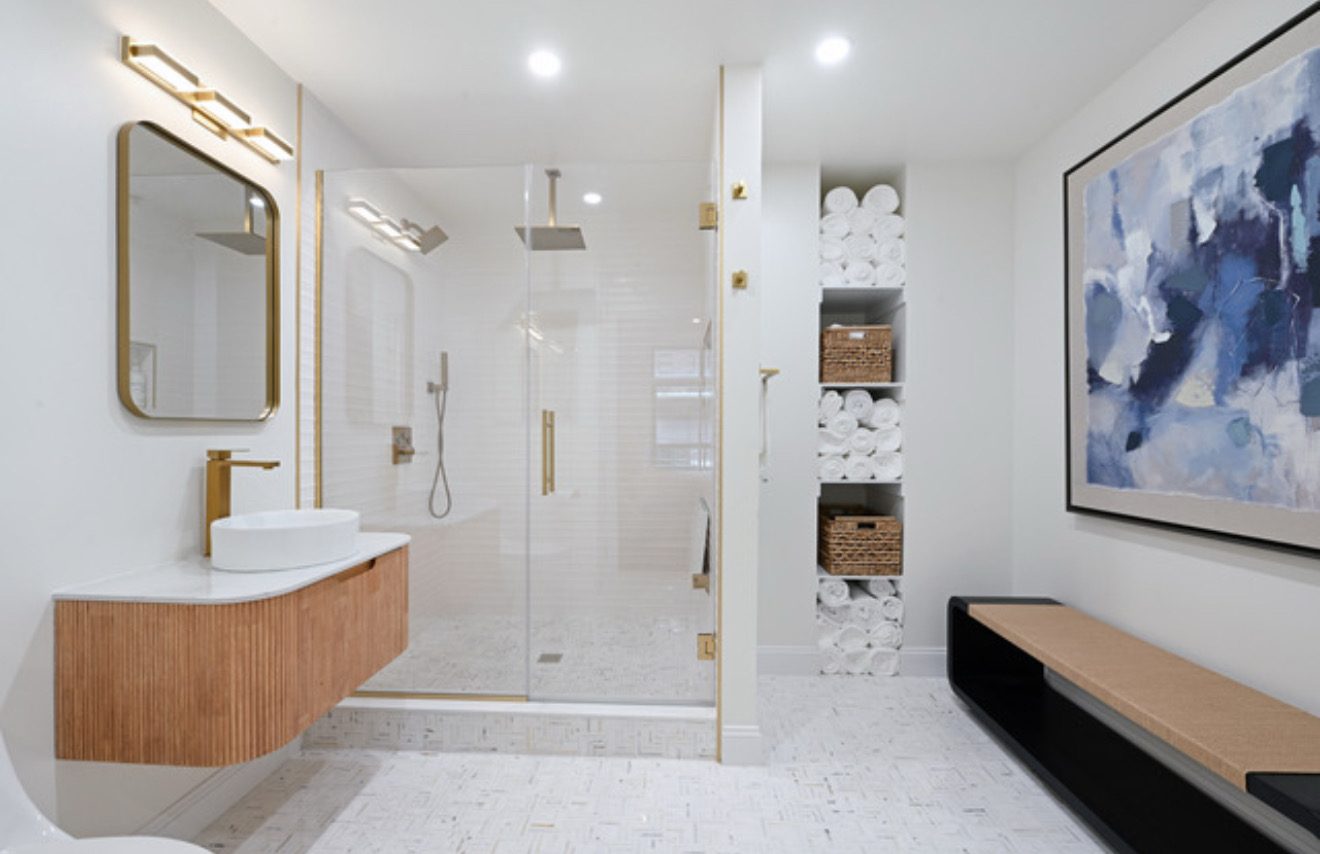
The most common custom mirror in any home. A vanity mirror runs from the top of the backsplash to the underside of the soffit (or the ceiling, in some primary baths), and from one wall to the other above a double or single sink. The wall-to-wall format makes the bathroom feel dramatically larger than a framed mirror floating in the middle of the wall, and it lets you integrate LED edge lighting so vanity lighting is built into the mirror itself rather than added as separate sconces.
For powder rooms and smaller secondary baths, framed or beveled mirrors set above the sink are still popular — see our custom mirrors page for examples of both formats. Vanity mirrors are almost always 1/4″ silvered mirror with a polished edge.
Home gym
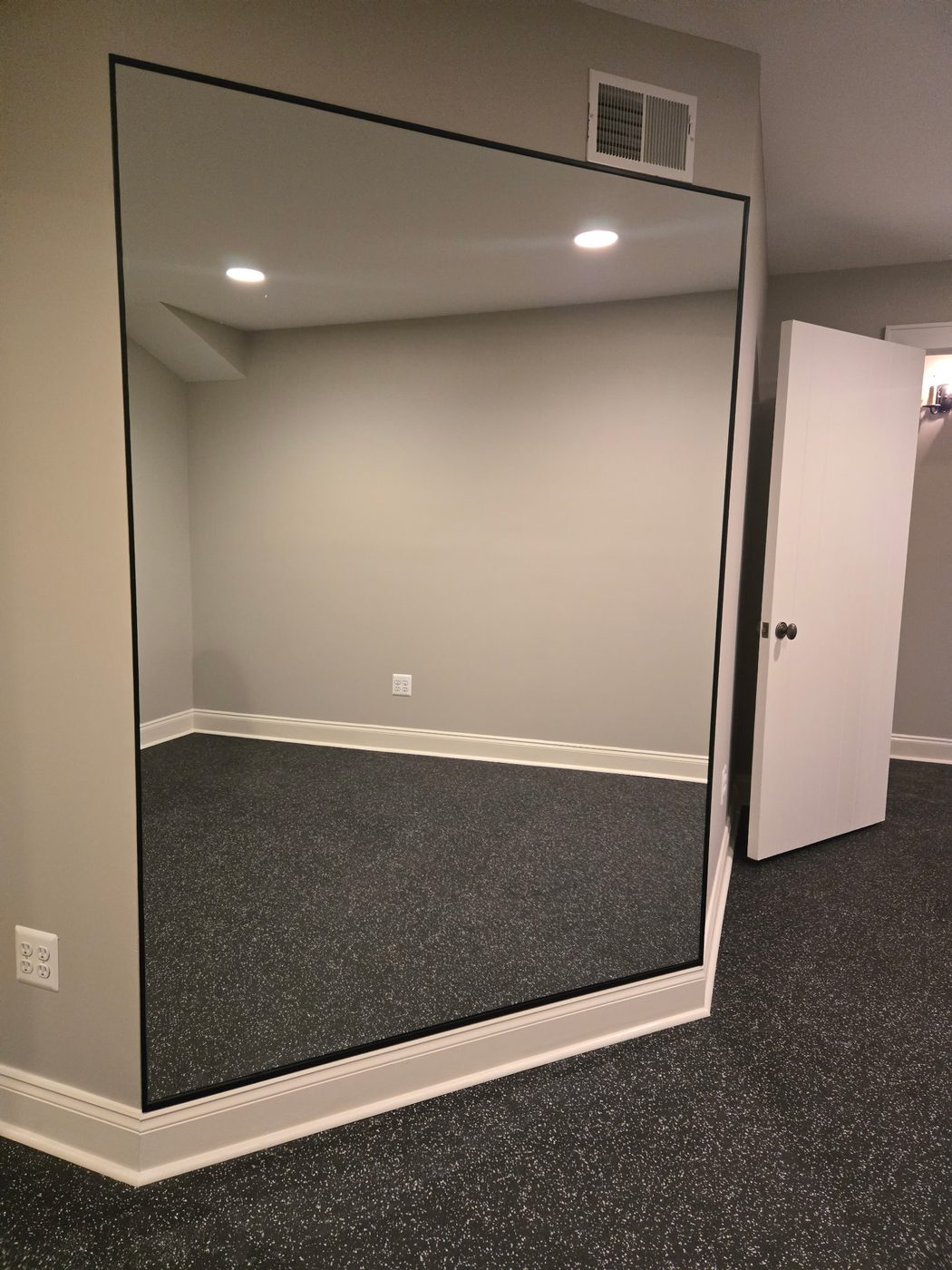
One of the fastest-growing categories in NJ since 2020. A full mirrored wall behind a free-weight or yoga space lets you check form during lifts, makes the room feel twice as large, and supplies the bright bounced light that gym spaces typically lack. Standard sizing is floor-to-ceiling (8–10 feet) and 12–20 feet wide, almost always seamed because single sheets that large are difficult to handle. Low-iron mirror (ultra-clear) is a strong upgrade in gym applications because it reflects workout-clothing colors more accurately than standard silvered mirror.
Entryway / foyer
A full-height mirror on the long wall of a foyer is a classic move that makes the entry feel grander and gives a last-look spot before you leave the house. These are often framed (especially in traditional homes) or beveled (in transitional homes), because the entry is a finished public space where the frame becomes part of the design. Antiqued mirror is a strong choice for entries in older NJ homes with character millwork — it pairs naturally with crown molding and chair rails.
Closet / dressing room
A full-length mirror on the back of a closet door or against a closet wall is essential in a primary bedroom. The custom version replaces the floppy framed mirror screwed to the back of a hollow-core door with a flush-mounted sheet behind a J-channel — much sturdier, much better-looking, and sized to the actual door rather than a generic 14″ × 50″ stock piece. Dressing rooms and walk-in closets often get a three-sided mirror arrangement (one tall mirror on each of three walls) for a true 360-degree view.
Bedroom feature wall
Less common but striking when it works. A full mirrored wall in a bedroom doubles the perceived size of the room and amplifies any natural light. The application calls for restraint — usually only one wall, behind the headboard or opposite the window — and the right mirror type. Smoked or bronze-tinted mirror reads softer and less harsh than plain silvered, which is the standard pick for bedroom installs.
Sizing & layout: single sheet vs. seamed
Modern mirror sheets are fabricated up to roughly 96″ × 130″ in a single piece — about 8 feet by nearly 11 feet. Most residential vanity, closet, and entryway walls fit in a single sheet at that size. Anything larger needs to be seamed.
A seam is a tight butt joint between two mirror sheets, with the cut edges polished smooth and the two pieces installed flush against each other. From conversational distance the seam is nearly invisible; up close you can see a hairline. We place seams at planned locations rather than randomly — typically aligned to architectural features (the center of a vanity, the corner of a ceiling soffit) so the eye accepts them as intentional.
| Wall size | Typical approach | Notes |
|---|---|---|
| Up to 96″ × 130″ | Single sheet | No seam; all residential vanities and most closets |
| 96″ – 144″ wide | 2-sheet seam, centered | Common in gym walls and wide foyers |
| 144″+ wide | 3+ sheet seams at planned points | Full-room gym installs, double-height entries |
Edge treatments: polished, beveled, ogee, framed
The edge of a custom mirror is where the visual personality of the install lives. Four options cover almost every project.
- Polished (flat polish). The default. A smooth, flat, slightly bullnosed edge that is invisible from straight on. Used on every vanity, gym, and contemporary mirror. The cleanest, most modern look.
- Beveled. A 1″ to 1-1/2″ angled cut along the perimeter that catches light and creates a faceted picture-frame effect. Traditional, slightly formal, beautiful in entries and dining rooms.
- Ogee. A decorative S-curve cut along the edge — more elaborate than a bevel. The right call for very formal traditional rooms.
- Framed. A separate wood, metal, or upholstered frame applied around the mirror after fabrication. Lets the mirror become a piece of furniture rather than a wall surface. Best where the rest of the room has strong millwork or built-ins to coordinate with.
Beveled and ogee edges are technically still frameless installs — they just have a decorative cut instead of a flat edge. Framed installs are a separate category and add 20–40% to the project cost depending on the frame material.
Mounting methods
How the mirror attaches to the wall affects how flush it sits, how visible the hardware is, and what wall surfaces are acceptable behind it. Three methods cover almost every install.
| Method | How it works | Best for |
|---|---|---|
| Mastic + J-channel | Mirror adhesive across the back, J-channel at the bottom | Full-wall installs, vanities, gym walls; flush, no visible hardware top or sides |
| J-channel only | Bottom rail captures the mirror; mirror floats on it | Smaller walls, situations where mastic is not desired |
| Hidden clips | Polished metal clips at top and bottom anchor to studs | Block walls, removable installs, very large single sheets |
Mastic is the workhorse method for large mirror walls because it sits dead-flush against the wall with no visible hardware anywhere except the bottom J-channel. The mastic itself is a mirror-safe adhesive (standard construction adhesives can chemically attack the silvering on the back of a mirror and cause black spots over time — we use only mirror-rated mastic). Hidden clips are the right call when the wall behind the mirror cannot accept adhesive, such as a painted cinder-block gym wall or a tongue-and-groove paneled accent wall.
Tip: Never let a contractor use generic liquid-nails on a mirror install. The wrong adhesive is the single most common cause of mirror black-spotting and silver failure within a few years.
LED lighting integration
Modern vanity and gym mirrors can integrate LED lighting in two main ways.
Edge-lit. A frosted band of mirror around the perimeter — typically 1″ to 2″ wide — is back-lit by an LED strip behind the mirror. The effect is a glowing frame of light around the reflective area. Edge-lit mirrors typically include a touch sensor on the face of the mirror to switch the light on and off, and many include a dimmer and color-temperature selector (warm white to cool daylight). The application most often spec'd is bathroom vanities, where the edge light provides flattering even illumination on your face for shaving and makeup.
Backlit (halo). The LED strip mounts to the wall behind the mirror, and the mirror itself stands off the wall by 3/4″ or so. The light glows out from behind the mirror against the wall, creating a halo effect. Backlit mirrors are typically used as a design feature where the mirror is intended to be a focal point — primary bath vanities, powder rooms, and entries.
Both integrations require a low-voltage transformer wired into the wall behind the mirror. The transformer is usually mounted in an accessible junction box. Coordinate with your electrician at rough-in so the supply wire and transformer location are confirmed before tile or drywall closes up the wall. For bathroom mirrors, a defogger pad (a heated pad on the back of the mirror) can be added on the same low-voltage circuit so the mirror surface stays clear after a hot shower.
Mirror types beyond plain silvered
Most custom mirror installs use standard 1/4″ silvered mirror, but several specialty types are available and worth considering for the right application.
- Antiqued. Mirror that has been chemically aged to look spotted and weathered. Strong fit for traditional baths, restaurant bars, entryways in older homes, and any space where the rest of the design is heritage rather than modern. Available in light, medium, and heavy aging.
- Smoked / Grey-tinted. Subtly grey reflection rather than crystal-clear silver. Modern, masculine, and reads softer than plain mirror. Beautiful in bedrooms and primary baths with matte-black hardware.
- Bronze-tinted. Subtle warm brown reflection. Pairs well with brass fixtures and walnut vanities. Often used in entryways and dining rooms where it adds warmth to the room.
- Low-iron mirror. Ultra-clear silvered mirror that reflects true colors without the slight green cast standard mirror introduces. The best pick for home gyms (workout clothing reads accurately) and dressing rooms (you see clothing colors as they actually are).
- One-way (transmission) mirror. A specialty option for hidden TVs and security applications — less common in residential work but available.
The installation process at AGM
Every custom mirror wall we build follows the same three steps.
1. Measure
We come to your home, talk through edge, mounting, lighting, and mirror-type options, and field-measure the wall. We check for plumb, look for any out-of-plane areas, locate studs for clip installs or LED wiring, and confirm any electrical rough-ins. You get a written quote with itemized line items — no obligation.
2. Fabricate
Once you approve the quote, the mirror is cut to your exact dimensions, the edges are polished or beveled, and any drill-throughs for hardware are completed. Fabrication runs 7–10 days for most residential projects. If you spec antiqued or tinted mirror, the lead time may extend a few days for the specialty material.
3. Install
Our own crew installs your mirror wall. For mastic installs, we prep the wall surface, apply the adhesive, set the mirror in place, and tape it for the 24-hour cure. For clip installs, we anchor the clips to studs and set the mirror in place. Most installs are a half day on site.
Cost factors
Most residential custom mirror walls in North Jersey fall between $30 and $60 per square foot installed for standard 1/4″ mirror with a polished edge mounted on mastic.
| Project | Typical range* |
|---|---|
| Vanity mirror (5′ × 4′) | $600 – $1,200 |
| Vanity mirror (8′ × 4′) | $1,000 – $1,800 |
| Closet / dressing-room mirror | $400 – $900 |
| Home gym wall (10′ × 8′) | $1,800 – $3,200 |
| Home gym wall (16′ × 10′) | $2,800 – $5,000 |
| Entryway statement mirror | $700 – $2,500 |
*General estimates for the North Jersey market. The factors that move the price most are size, mirror type (specialty mirrors like antiqued or low-iron carry an upcharge), edge treatment (bevel and ogee are extra), LED integration (typically $400–$1,200 more depending on the system), and site conditions (second-floor stair carries, custom seaming).
Care & cleaning
Mirror is the easiest finished surface in your house to maintain. The two-bottle routine handles 95% of all cleaning:
- Bottle 1: distilled water + white vinegar (50/50). Spray on a clean microfiber, wipe the mirror, no spray directly on the glass. Vinegar cuts soap film and water spots.
- Bottle 2: dry microfiber. Immediately polish dry. This is the step that eliminates streaks.
What to avoid: Ammonia-heavy cleaners on antiqued and tinted mirror — the ammonia can creep into the cut edges over time and degrade the silvering. Abrasive scrubbers (steel wool, scouring pads) on any mirror. Letting water stand against the edge of a mirror, especially in bathrooms — repeated edge exposure is the single biggest cause of black-spot silver failure on bathroom mirrors. A quick edge-wipe after spillage protects the silver for decades.
Common pitfalls to avoid
After 40+ years of custom mirror installs in North Jersey, these are the mistakes we see most often when a homeowner has used a low-bid shop or a handyman install:
- Wrong adhesive. Generic construction adhesive ("liquid nails" style products) chemically attacks the silver backing on mirrors and causes black spots to bloom along the back within a few years. Only mirror-rated mastic should ever touch the back of a mirror — the can is clearly labeled and costs the same as any other adhesive.
- No edge wipe in bathrooms. Water that runs down the face of a bathroom mirror and pools at the bottom edge eventually wicks behind the silver and causes edge black-spotting. A quick wipe after splashes — or installing the mirror with a tiny clearance gap above any backsplash so water never reaches the bottom edge — prevents it.
- Skipping seam planning on large walls. If a wall is too big for a single sheet, the seam location should be planned (centered, aligned to the vanity, aligned to a soffit edge). Random seams placed wherever the truck happened to deliver the glass look unintentional and cheapen the install.
- Wallpaper still on the wall. Wallpaper has to come down before any mastic install. The paper cannot reliably hold a heavy mirror and will eventually separate from the wall with the mirror still attached. Removing wallpaper at install adds time and dust; doing it before the install is much cleaner.
- Forgetting the LED rough-in. Edge-lit and backlit mirrors need a low-voltage transformer wired into the wall behind the mirror. If electrical rough-in is not coordinated with the mirror order, the wall has to be opened later — expensive and avoidable with one conversation at measure.
- Mismatched edges across multiple mirrors. In dressing rooms with three or more mirror walls, every mirror should share the same edge treatment. Mixing a polished edge with a beveled edge across panels reads as inconsistent.
Why Bergen County trusts AGM for mirror work
Three reasons homeowners and designers in North Jersey call us back for mirror projects:
- In-house fabrication. The mirror is cut, edged, polished, and (for specialty types) sourced through our own shop in Lodi. We carry standard, low-iron, antiqued, smoked, and bronze mirror, plus the LED systems and defogger pads to integrate them.
- Mastic done right. The most common mirror failure we see when called for repair work is the wrong adhesive — generic construction adhesive that has attacked the silvering. Every install we do uses mirror-rated mastic.
- Coordination with your trades. We coordinate with electricians on LED rough-ins and with general contractors on tile schedule so the mirror lands on a clean, prepped wall at the right point in the project.
Ready to start your project?
Tell us about your wall and we will schedule a free in-home measure — firm quote, no obligation, samples brought to you.
Get a Free In-Home Measure