Quick answer: The edge of a glass tabletop decides whether the piece reads as cheap or custom. Five finishes cover essentially every project: pencil (rounded half-round), polished flat (crisp 90-degree, fully polished), seamed (industrial, edges only dulled), beveled (wide angled cut at the top face), and ogee (S-curve decorative profile). Pencil is our default on residential jobs; polished flat is the close second on modern designs; beveled and ogee belong on traditional and formal pieces; seamed is a budget finish used only when the edge is hidden.
This guide walks each option — what it looks like, where it fits, what it costs. Pair it with our full glass tabletops buyer's guide for the rest of the decisions (thickness, shape, mounting), or jump to the comparison table.
The edge finish comparison, at a glance
Five finishes cover essentially every tabletop edge we cut. Each has a distinct look, best-use case and cost premium over the cheapest finish (seamed).
| Edge style | Look | Best use | Cost premium | Touch & feel |
|---|---|---|---|---|
| Seamed | Industrial — square corner, dulled but not polished | Hidden edges only (protective tops, behind frames) | Baseline (cheapest) | Smooth enough to handle safely, but visibly rough |
| Pencil | Soft — fully rounded half-round profile | Most residential tabletops, all coffee tables, family-friendly use | +30–50% over seamed | Warm, comfortable, forgiving — no hard line |
| Polished flat | Crisp — 90-degree corner with all three faces polished glossy | Modern and minimalist designs, gallery and showroom interiors | +30–50% over seamed | Architectural — you feel the geometry |
| Beveled | Faceted — wide 3/4″–1″ angled face cut into the top of the glass | Traditional dining tables, formal mirrors, credenza tops | +90–130% over seamed | Crisp, multi-faceted — catches light at every angle |
| Ogee | Ornate — decorative S-curve profile mimicking traditional furniture | Formal Victorian, Georgian and transitional dining tables | +140–200% over seamed | Heavily sculpted — reads as furniture-grade |
By far the most common finish we cut is the pencil edge — our default for any residential piece when a customer doesn't ask for something specific. Polished flat is the alternative on modern designs. Beveled and ogee together make up roughly 10 percent of our tabletop edge work.
Seamed edge: the industrial baseline
A seamed edge is the most basic finishing step glass receives after it's cut. The sharp 90-degree edge is run lightly against a belt sander to dull the corner enough that the glass is safe to handle. The face stays rough — visibly so up close. It is not a decorative finish.
On tabletops, seamed edges show up only where the edge is hidden and cost is the deciding factor: a protective top over wood flush against a raised apron, or a glass insert wrapped by a furniture frame. Anywhere the edge is invisible, a seamed finish saves 30–50 percent. Anywhere it's visible, it looks unfinished — and we recommend a polished finish instead.
Pencil edge: the all-rounder
The pencil edge is the default residential tabletop finish. The edge is ground and polished into a smooth half-round profile — rounded on both faces, meeting at a soft apex in the middle. From above, the corner disappears into a soft radius rather than a hard line.
Where it fits. Essentially every residential interior style — contemporary, transitional, warm-modern, Scandinavian, mid-century. It reads as quiet and refined rather than statement.
Why it wins for families. The rounded profile is the most forgiving finish to the touch — no hard edge for elbows, no sharp corner for a toddler's forehead. Households with kids almost always end up on pencil.
Cost. On a 48 by 24 inch tempered top, a pencil edge runs roughly $80 to $140 depending on thickness — the baseline we quote against.
Polished flat edge: crisp and modern
The polished flat edge keeps the original 90-degree corner of the cut glass but grinds and polishes all three faces — top, bottom and the vertical face — to a smooth, glossy finish. The corners are typically very slightly arrissed (a tiny chamfer) so they don't chip, but visually the edge looks square.
Where it fits. Modern, minimalist, gallery and showroom-style interiors. Architectural offices and contemporary executive desks. Anywhere the geometry of the glass is part of the design statement.
Pencil vs. polished flat. Pencil softens the silhouette; polished flat keeps it sharp. Polished flat reads as more architectural; pencil reads as more residential. Cost is roughly the same — it's a style call.
Beveled edge: faceted and traditional
A beveled edge cuts a wide angled face into the top of the glass — typically 3/4 inch to 1 inch wide, sometimes up to 1-1/2 inch on heavier glass — and polishes the facet glossy. Light catches the bevel and refracts subtly along its length, which is the visual point.
Where it fits. Traditional dining tables, formal credenza tops, custom dressing tables and ornate mirrors. Anywhere the surrounding furniture is itself traditional — carved wood, turned legs, antique-style hardware — and the glass needs to read as a furniture-grade element.
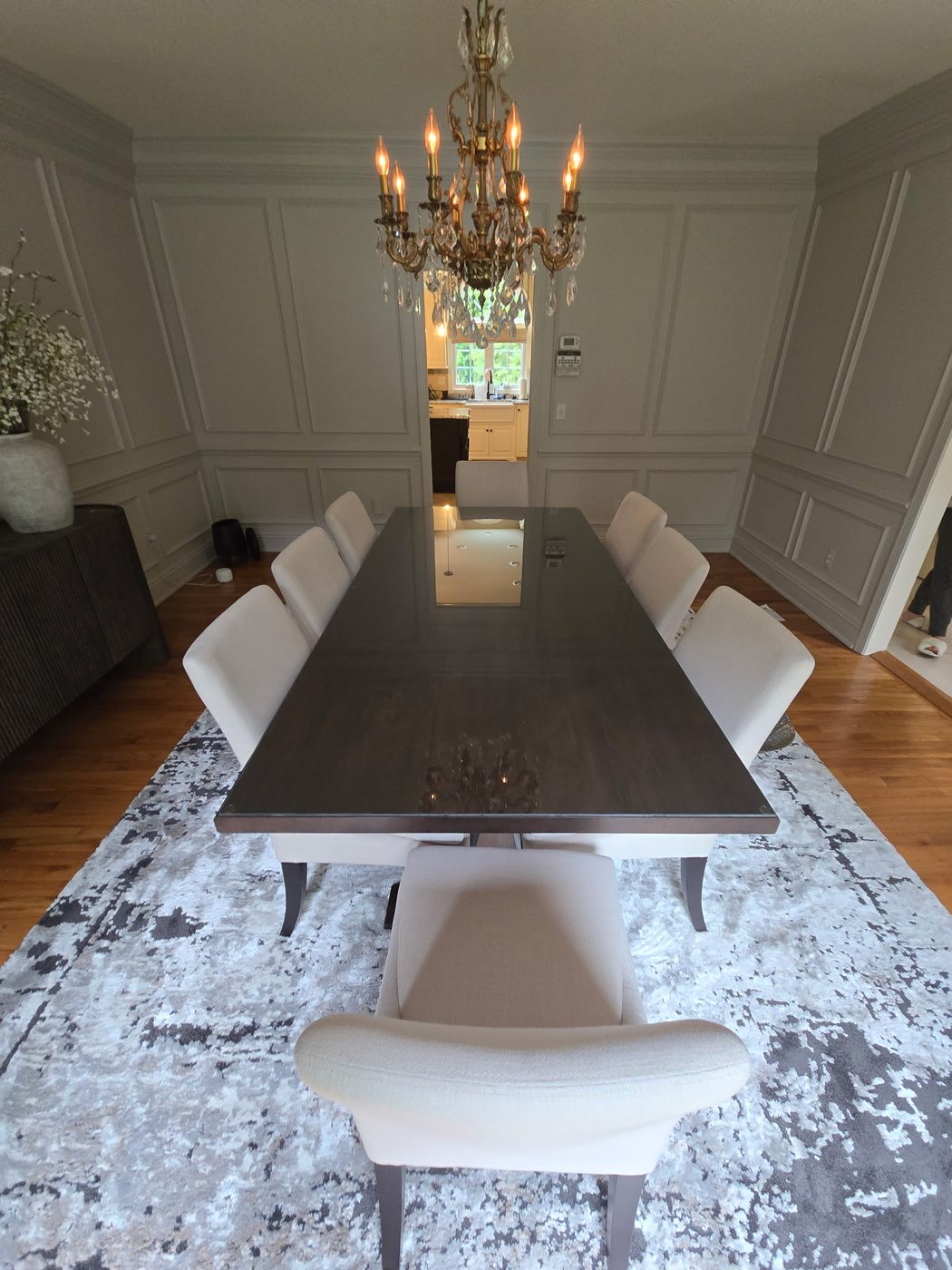
Visual character. The bevel sparkles under a chandelier or directional ceiling fixture. On a traditional dining table, that's the intended effect. On a coffee table in a modern living room, the same sparkle reads as fussy and dated.
Cost. A beveled edge typically runs 40 to 70 percent more than pencil. On a 48 by 24 inch tempered top, a 3/4 inch bevel runs roughly $130 to $220.
Ogee edge: ornate and furniture-grade
The ogee edge is the most decorative profile we offer. It's an S-curve — a convex curve on top transitioning into a concave curve below, finishing into the bottom face of the glass. The profile mimics the molded edge of a traditional wood or stone furniture top.
Where it fits. Formal Victorian, Georgian, French Provincial and transitional dining tables. Ornate credenzas, dressing tables and console tops. The ogee is the right call when the entire room is built around traditional craftsmanship — modern designs almost never call for one.
Visual impact. Significant. The ogee is heavily sculpted and reads as ornate even from across a room. On the right piece, that's the point.
Cost. Ogee is the most expensive standard edge we cut — typically 80 to 120 percent more than pencil. On a 48 by 24 inch tempered top, roughly $200 to $310.
Edge samples on every measure: We bring physical edge samples to every in-home measure. The difference between pencil, polished flat and beveled is much easier to feel and see in person than in a photograph — and the right call usually becomes obvious within a few seconds of holding the samples next to the room's existing furniture.
How to choose: matching the edge to the room
The edge finish should match the surrounding furniture's visual vocabulary, not the glass itself. The glass is neutral — it picks up whatever character the edge gives it. A few decision rules:
Modern, contemporary, minimalist room? Polished flat is the default; pencil is the comfort-first alternative.
Transitional, warm-modern, Scandinavian, mid-century? Pencil edge, every time. The soft profile pairs with both painted wood and warm metal bases without competing.
Traditional, formal, classic dining room? Beveled if the surrounding furniture is moderately traditional; ogee if the room is fully formal. Skip pencil — a soft modern edge undersells the rest of the room.
Protective top over a wood dining table? Pencil if the glass is visible at the edge (most cases). Seamed if a raised lip or apron hides the perimeter.
Households with young kids? Pencil. The rounded profile is genuinely easier on heads, elbows and sweater sleeves than any of the angular alternatives.
Edges and tempering: lock it in before the oven
Edge finishes have to be applied before tempering. Once glass goes through the tempering oven, it cannot be re-cut, re-drilled or re-edged — any post-temper modification will shatter the panel. The edge profile is a permanent decision finalized at the time of the order, alongside dimensions, thickness and any holes for hardware. See our glass tabletop thickness guide for the same warning about thickness — both decisions are locked in pre-temper.
Not sure which edge is right for your piece?
We bring physical samples of every edge profile to in-home measures across Bergen, Passaic, Hudson and Essex counties. Free measure, written quote back the same business day.
Get a Free QuotePutting it all together
Edge finish is a small detail with outsized impact on how a glass tabletop reads in a room. The default cascade: residential coffee table or desk? Pencil. Modern statement piece? Polished flat. Traditional dining room? Beveled. Formal furniture-grade piece? Ogee. Hidden edge or strict budget? Seamed.
For the full set of decisions on a custom tabletop, see our pillar guide on glass tabletops in NJ. For thickness, read our glass tabletop thickness guide. For desks, see custom desk glass for home offices. For the service page, see tabletops. Want a hand picking the right edge? Call Jessica at (201) 460-1313 — we'll bring physical samples to the measure.