Quick answer: Tempered back-painted glass is rated for sustained surface temperatures up to roughly 400°F, which covers virtually every modern fireplace surround with appropriate clearance from the firebox. Single panels can be fabricated up to 60 by 130 inches — enough for most floor-to-ceiling accent walls without seams. Custom etching, sandblasted designs and printed logos are all routine additions. The two biggest considerations are heat clearance (set by the fireplace appliance) and panel layout (where any necessary seams will fall).
For the full guide to the material itself, see our complete back-painted glass buyer's guide. This article focuses on applications beyond the kitchen — fireplace surrounds, accent walls, and the design moves that work in non-backsplash installations.
Fireplace surrounds
Back-painted glass is a striking fireplace surround material. The glossy front face catches the flicker of the fire and reflects it back into the room; a dark surround (charcoal, deep forest, near-black) makes the glow of the firebox visually pop, while a light surround (warm white, soft greige) creates a clean contemporary frame around the flames.
The application works best with modern direct-vent gas fireplaces, which have predictable heat output, well-defined clearance requirements, and surface temperatures that stay comfortably within the glass's thermal rating. Wood-burning fireplaces and high-output gas units have larger clearance requirements and may need fire-rated specialty glass — both are doable, but they require closer attention to the appliance's UL listing.
Heat and clearance
Tempered glass with the painted backing layer is rated for sustained surface temperatures up to roughly 400°F. A typical direct-vent gas fireplace produces wall surface temperatures of 150–250°F directly above the firebox — well below the rating. The non-combustible clearance requirement from the appliance manufacturer (usually 6 inches above, 1–2 inches to the sides) is the binding constraint, not the glass thermal rating. Wood-burning fireplaces have larger clearances (typically 12 inches above, 6 inches to the sides) and the glass starts further back. Provide the fireplace's make, model and UL listing and we'll work from the manufacturer specs and local NJ code to confirm the exact envelope.
Design ideas for fireplace surrounds
- Deep charcoal or near-black surround. The most dramatic effect — fire glow against the dark glass creates a striking modern focal point.
- Warm white or soft greige surround. Transitional and sophisticated; pairs well with stone or marble hearths.
- Floor-to-ceiling feature wall with the firebox embedded in the center. The entire wall is a single seamless color plane with the fire as the focal element.
- Painted glass with stone or wood mantel. Modern panel above, traditional material below — a layered effect.
Accent walls
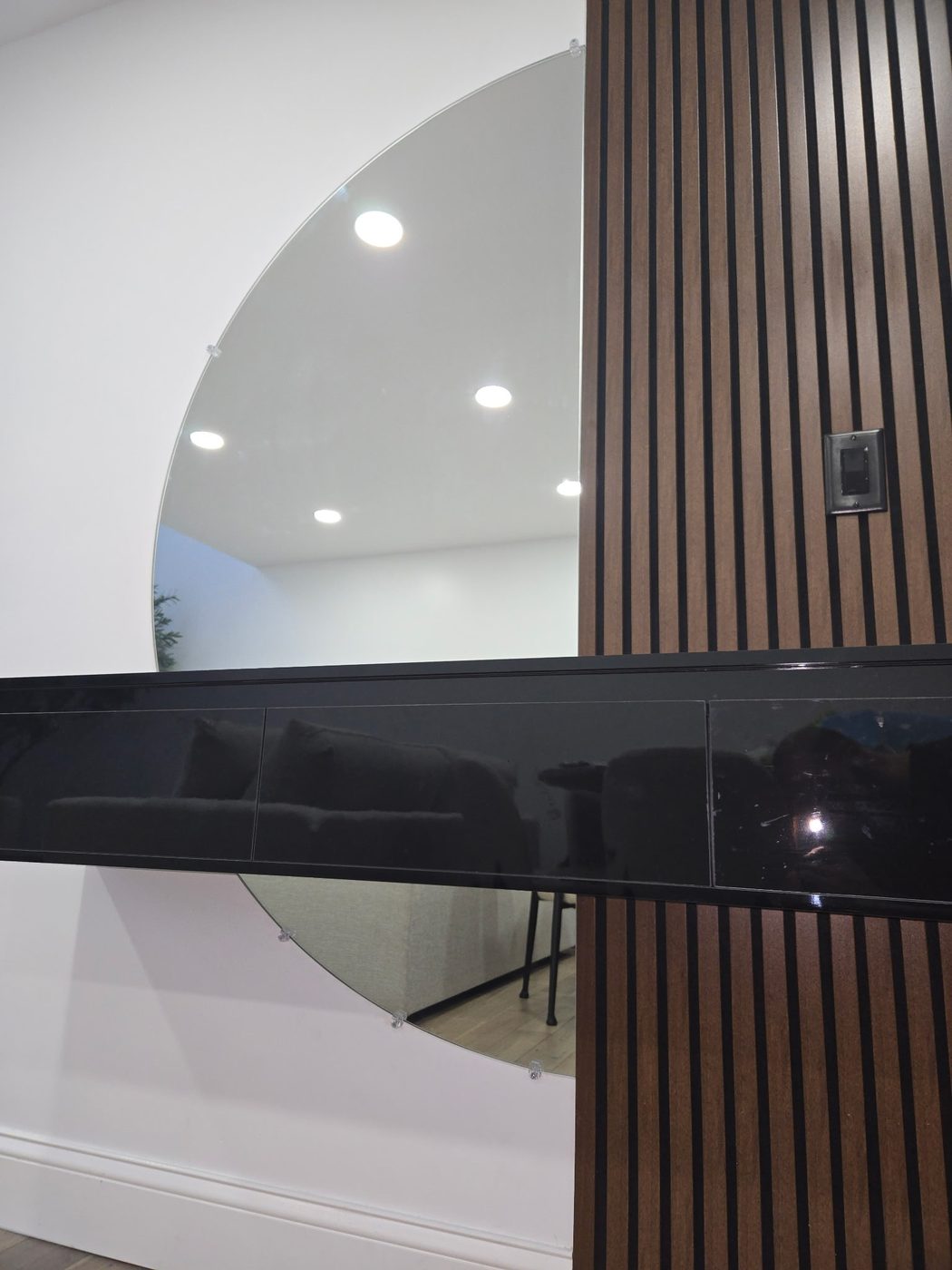
Beyond fireplaces, back-painted glass works as a full accent wall material in living rooms, dining rooms, primary bedroom headboard walls, home offices, and almost any space where a single statement wall would otherwise be done in wallpaper, paint, paneling or stone veneer.
The advantages over alternatives: vs. paint, glass produces a depth of color and reflective luminosity no painted wall achieves. Vs. wallpaper, glass delivers a quieter seamless color plane (different intent). Vs. wood paneling or stone veneer, glass is cleaner and lower-maintenance. Vs. tiled feature wall, glass has zero grout and zero joints.
Panel layout and seams on large walls
A single panel can be fabricated up to 60 by 130 inches — enough for most residential accent walls floor-to-ceiling, or wall-to-wall on a 10-foot living room wall, as a single seamless piece. Larger walls are built from multiple panels with tight butt seams sealed in clear silicone (visible on close inspection, but read as a thin pinstripe from normal viewing distance), mitered seams for corner walls, or intentional reveal joints as a design feature. We plan seams to fall at natural break points — at a corner, behind furniture, aligned with a fireplace edge — rather than landing them mid-plane.
| Wall size | Layout | Seam status |
|---|---|---|
| Up to 60″ × 130″ | Single panel | Seamless |
| Up to 120″ × 130″ | 2 panels side-by-side | 1 tight butt seam (vertical) |
| Up to 180″ × 130″ | 3 panels side-by-side | 2 tight butt seams (vertical) |
| Up to 60″ × 260″ (tall feature) | 2 panels stacked | 1 tight butt seam (horizontal) |
| Corner / L-shaped walls | Mitered or butt-joined panels | Mitered corner reads seamless from normal distance |
Custom logos, etching and printed artwork
One advantage of back-painted glass over almost every other wall material is the ability to integrate custom artwork. Sandblasted or acid-etched designs on the front face produce a satin-frosted texture that contrasts with the surrounding glossy finish — common for business logos, family monograms, and decorative patterns. Printed or applied artwork behind the paint layer becomes visible through the front in full color and is used for brand graphics and complex multi-color logos. Etching adds 20–40% to panel cost; printed artwork can double it, but the result is meaningful for branded commercial spaces and high-end residential statement walls.
Have a fireplace, accent wall or office logo project?
Jessica will walk through your space, confirm clearances and code where applicable, and quote the painted glass panel — etched or printed if needed. Most quotes returned within one business day.
Get a Free On-Site Consultation
Commercial applications
Beyond residential fireplaces and accent walls, painted glass is widely used in North Jersey commercial spaces.
- Office reception walls with the company logo etched or printed into the panel. Combines brand visibility with a high-end material finish; replaces traditional painted-and-vinyl logo walls.
- Conference room feature walls in deep brand colors, often with subtle etched patterns. Reads as premium and intentional in client meetings.
- Retail accent walls behind point-of-sale stations and in display areas. The seamless surface is durable in high-traffic commercial environments and easy to clean.
- Restaurant and hospitality interiors with painted glass behind bars, in private dining rooms, and as feature elements in lobbies and corridors.
- Medical and dental office accents — the non-porous easy-clean surface meets hygiene requirements in healthcare environments while providing a calming color palette.
Commercial installations have additional considerations: fire-rating compliance for interior wall finishes (typically Class A or Class B flame spread, which tempered glass with paint backing meets), ADA-related setback from circulation paths, and integration with existing signage or branding. We've handled these for office, medical and retail clients across Bergen, Passaic, Hudson and Essex counties.
For more on commercial glass work, see our commercial glass guide.
Cost and lead times
Pricing tracks the same cost drivers as kitchen backsplash work — square footage, thickness, color, finish, artwork — but project sizes are larger. Rough ballparks:
- Fireplace surround panel (30–60 sq ft): $2,500–$6,000 installed.
- Residential accent wall (50–80 sq ft): $4,000–$10,000 installed.
- Full-height feature wall (80–120 sq ft): $7,000–$16,000 installed.
- Office reception wall with etched logo (60–100 sq ft): $6,000–$14,000 installed.
- Commercial brand wall with printed full-color artwork: $12,000–$30,000+ depending on complexity.
Timeline follows the same pattern as kitchen work: in-home measure, templating, 2–3 weeks of off-site fabrication, install in 4–8 hours. Fireplace surrounds and small accent walls wrap in a single install day; very large feature walls may run 1–2 days.
Putting it together
Back-painted glass is meaningfully more versatile than its kitchen-backsplash reputation suggests. The same panels that make a beautiful kitchen wall make striking fireplace surrounds, sophisticated residential accent walls, and high-end commercial brand walls. The material constraints — single-panel size, heat clearance, custom artwork techniques — are well-understood and routine to design around.
For any non-kitchen application, the right starting point is an on-site visit. Bring the room's purpose, the fireplace appliance spec (if applicable), color preferences, and any reference imagery, and we'll work backward from the space to the right panel layout, color and finish. Most projects move from initial consult to install in 4–6 weeks.