Quick answer: A typical retail or office storefront in North Jersey costs $75–$225 per square foot installed. Single-pane framed aluminum with tempered glass: $75–$110/sf. Insulated dual-pane with low-E: $110–$160/sf. Frameless all-glass entries with 1/2-inch tempered: $175–$300/sf. Doors with hardware (panic devices, closers) add $2,500–$7,500 each. The price drivers are glass spec, framing system, access, and whether the work is during business hours or after.
If you already have drawings or a damage scope and just need a budget number, jump to cost ranges by system. If you're scoping a project from scratch, start at the top — the spec decisions are what set the price.
What goes into a commercial storefront quote?
A commercial storefront is more than just glass. The full assembly on a typical retail or office front includes: glass panels (the fixed lites that span between framing), framing (the aluminum extrusions that hold the glass — sill, head, jambs and verticals), doors (single or pair, with hardware and closers), transoms (the panel above the door), weatherproofing (gaskets, sealant, sweeps), and any specialty items like panic bars, electric strikes, automatic openers or signage attachments.
Every one of those line items has a spec range, and the range is wide. The same 200-square-foot storefront could be $15,000 in basic spec or $45,000+ in premium spec. Knowing what's required by code, what's required by your insurance, and what's optional polish makes the difference between a competitive quote and a wasted budget.
For our full commercial offering, see our commercial glass page. For the broader strategy on offices and storefronts in NJ, the commercial storefronts and offices pillar guide covers the full picture.
Cost by storefront system
Storefronts get categorized by framing system and glazing type. The four buckets below cover roughly 95% of the commercial work we quote across Bergen, Passaic, Hudson and Essex counties.
| System | Installed cost | Where it fits |
|---|---|---|
| Framed aluminum, single-pane tempered | $75 – $110 / sf | Unconditioned entries, vestibules, parking-deck enclosures, budget builds |
| Framed aluminum, insulated dual-pane (clear) | $95 – $135 / sf | Standard conditioned retail and office, base IG spec |
| Framed aluminum, insulated dual-pane low-E | $110 – $160 / sf | Modern code-compliant retail and office — the most common spec we install |
| Thermally broken framed aluminum, IG low-E + laminated | $140 – $200 / sf | Class A office, jewelry/electronics retail, banks — premium thermal and security |
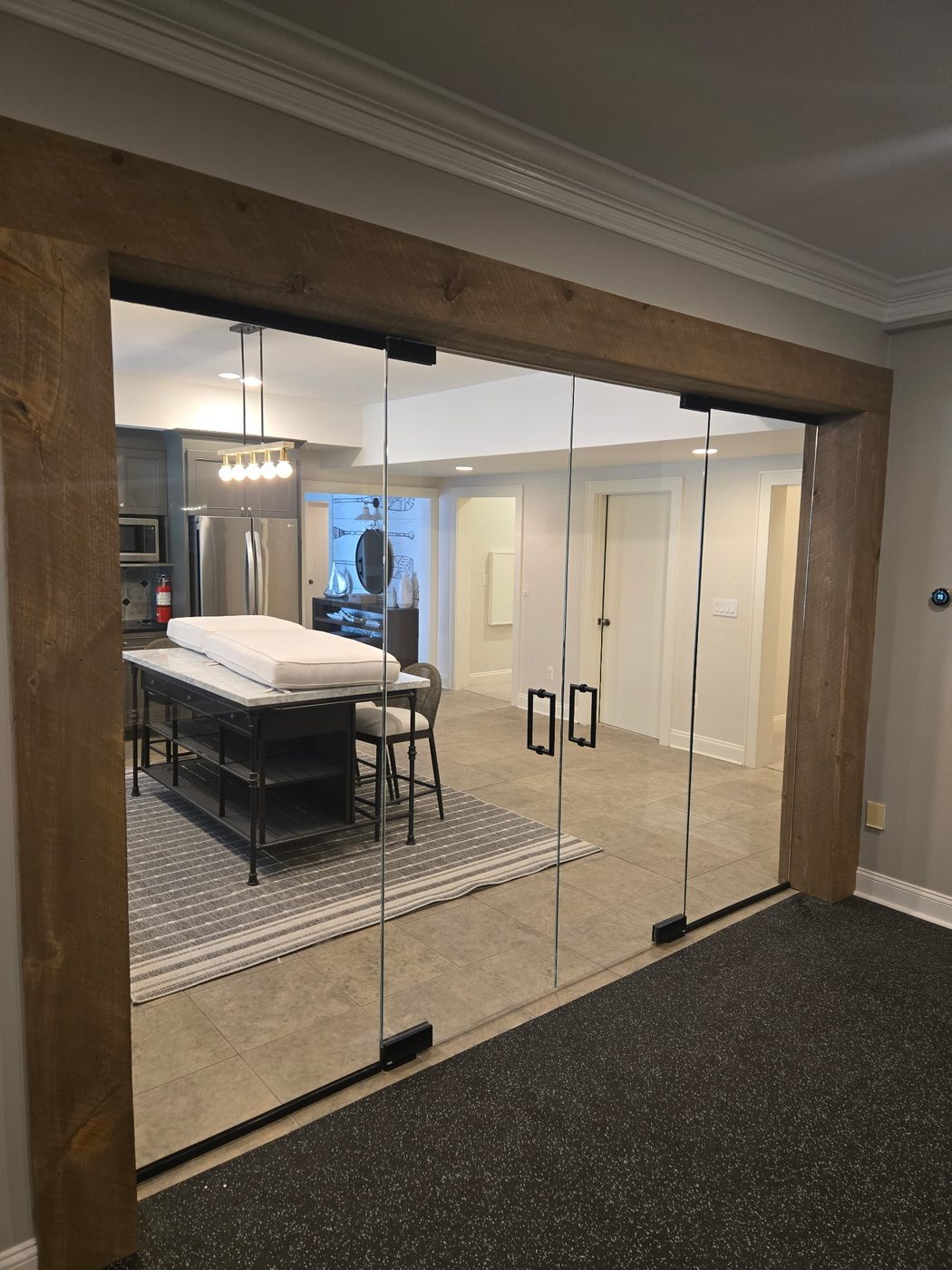
| Frameless all-glass entry, 1/2″ tempered | $175 – $300 / sf | Boutique retail, restaurants, lobbies — minimalist architectural look |
| Frameless storm/security-rated (laminated + tempered) | $250 – $400 / sf | Storm-impact zones, high-security tenants — laminated outer + tempered inner |
The numbers above are installed ranges that include glass, framing, sealants, basic hardware and standard daytime install on a ground-level storefront. They do not include doors with full hardware packages, custom-color finishes, after-hours work or sidewalk permits.
What the code requires (which sets the floor)
NJ commercial construction code mandates safety glazing in nearly every storefront panel — which means tempered glass at minimum on most panels. The specific triggers are spelled out in the IBC (International Building Code) Chapter 24, which NJ has adopted with state amendments.
Tempered (safety) glass is required in any panel that meets any of these conditions: within 24 inches horizontally of a door swing, within 60 inches vertically of a walking surface and larger than 9 square feet, within 36 inches of a stair or ramp landing, or any panel in a door or sidelite. In practice, that means every panel on a typical storefront is tempered.
Laminated glass is required for: panels above pedestrian walkways (sometimes), security-rated openings (banks, jewelry, pharmacy), and any application where the building official has invoked Section 2406.4 of the IBC for overhead glazing. Many North Jersey storefronts also voluntarily upgrade to laminated outer panes for forced-entry resistance — the laminated interlayer holds the glass together even when broken, slowing down smash-and-grab break-ins.
Insulated glass with low-E coating is required by NJ energy code on most new conditioned commercial fenestration. The U-factor maximum is 0.45 (lower is better) and the SHGC (Solar Heat Gain Coefficient) maximum depends on orientation. Single-pane storefronts are still legal for unconditioned spaces and for like-for-like replacements in existing buildings, but new construction and major renovations have to meet the energy code.
Tip: If you're replacing damaged panels in an existing single-pane storefront, you can usually do a like-for-like single-pane tempered replacement without triggering an energy-code upgrade — the existing assembly is grandfathered. Full framing replacement does trigger the upgrade.
Doors and hardware
The door is usually the most expensive 4 square feet of a storefront. A bare door panel is similar in cost to a fixed panel of the same glass — but the hardware on a commercial door routinely runs $1,500 to $5,000 on top of the door itself.
| Hardware item | Typical add | When you need it |
|---|---|---|
| Standard pull, push bar, closer, threshold | $600 – $1,200 | Every commercial door — included in base door pricing |
| Panic exit device (push-bar exit) | +$800 – $1,800 | Required by code for any door serving 50+ occupants, all assembly use |
| Electric strike (buzzer access) | +$1,000 – $2,500 | Controlled-access offices, after-hours buzzer entry |
| Card reader integration | +$1,500 – $4,000 | Class A offices, secure tenants — hardware only, not the access system |
| Automatic ADA operator | +$2,500 – $5,000 | Public buildings, medical offices, ADA upgrades |
| Heavy-duty pivot or hydraulic floor closer | +$1,500 – $3,500 | Frameless all-glass entries, restaurants, high-traffic retail |
The most common pattern we see on NJ retail and office storefronts is a single pair of framed aluminum doors with a continuous push bar, hydraulic closers, ADA-compliant threshold and a panic device on the egress side. That hardware package adds roughly $2,500 to $3,500 per door pair over the base door cost.
What drives the price up on a storefront
Beyond the system choice, six factors move a quote significantly. Knowing them ahead of time helps you scope realistically.
Glass spec upgrades
Going from tempered to laminated adds roughly 30–50% to the glass cost. Adding low-E coating to insulated glass adds 15–25%. Going from clear to low-iron (water-clear glass with no greenish edge tint, popular on premium retail) adds 30–50%. Tinted, reflective and decorative glass each have their own cost lines. On a 300-square-foot storefront, spec upgrades alone can swing the total by $8,000 to $20,000.
Framing system and finish
Stock-color framing (clear anodized, dark bronze, black, white) is the base. Custom-color anodized or painted finishes add 20–40% to the framing cost and 2–4 weeks to lead time. Thermally broken frames (with a thermal break inside the extrusion to stop heat transfer) cost 30–60% more than non-thermal and are required for high-performance energy code compliance on new construction.
Height and access
Anything above 12 feet typically requires a scissor lift, boom lift or scaffold. Lift rental on a routine storefront install runs $400 to $1,000 per day. Two-story atrium glass, lobby curtainwall, and high-mounted transoms can add $2,000 to $8,000 in equipment and labor compared to a ground-level install.
After-hours and weekend work
Occupied retail and office storefronts often require install outside business hours. Overnight (10pm to 6am) or weekend work adds 25–50% to labor compared to standard daytime. For a $20,000 install, that's a $5,000 to $10,000 swing — but it's often worth it to keep the business open during the day.
Permitting and traffic control
Most municipalities in Bergen County require a permit for commercial glass replacement. Permit fees run $150 to $600 depending on town. Sidewalk closure permits (required for any work that blocks pedestrian access) add another $200 to $500 and a few days of lead time. Traffic-control flaggers, if required, run $400 to $800 per day.
Removal and disposal of existing glass
Existing storefront glass and any compromised framing has to be safely removed and hauled off. On a like-for-like replacement, this is typically $300 to $1,500 depending on size and condition. Hazardous removals (broken laminated glass with the interlayer still attached, glass with safety film, decommissioned security glass with embedded wire) cost more.
Storefront vs entrance: budget patterns
Three real-world budget patterns from recent North Jersey projects:
- Small retail like-for-like replacement — 12-foot-wide, 8-foot-tall storefront with single door, single-pane tempered into existing frames. Three panels and one door. $8,000 – $14,000 installed.
- Office storefront upgrade — 24-foot-wide, 10-foot-tall storefront with paired doors, insulated low-E glass in new thermally broken frames, panic hardware. $28,000 – $45,000 installed.
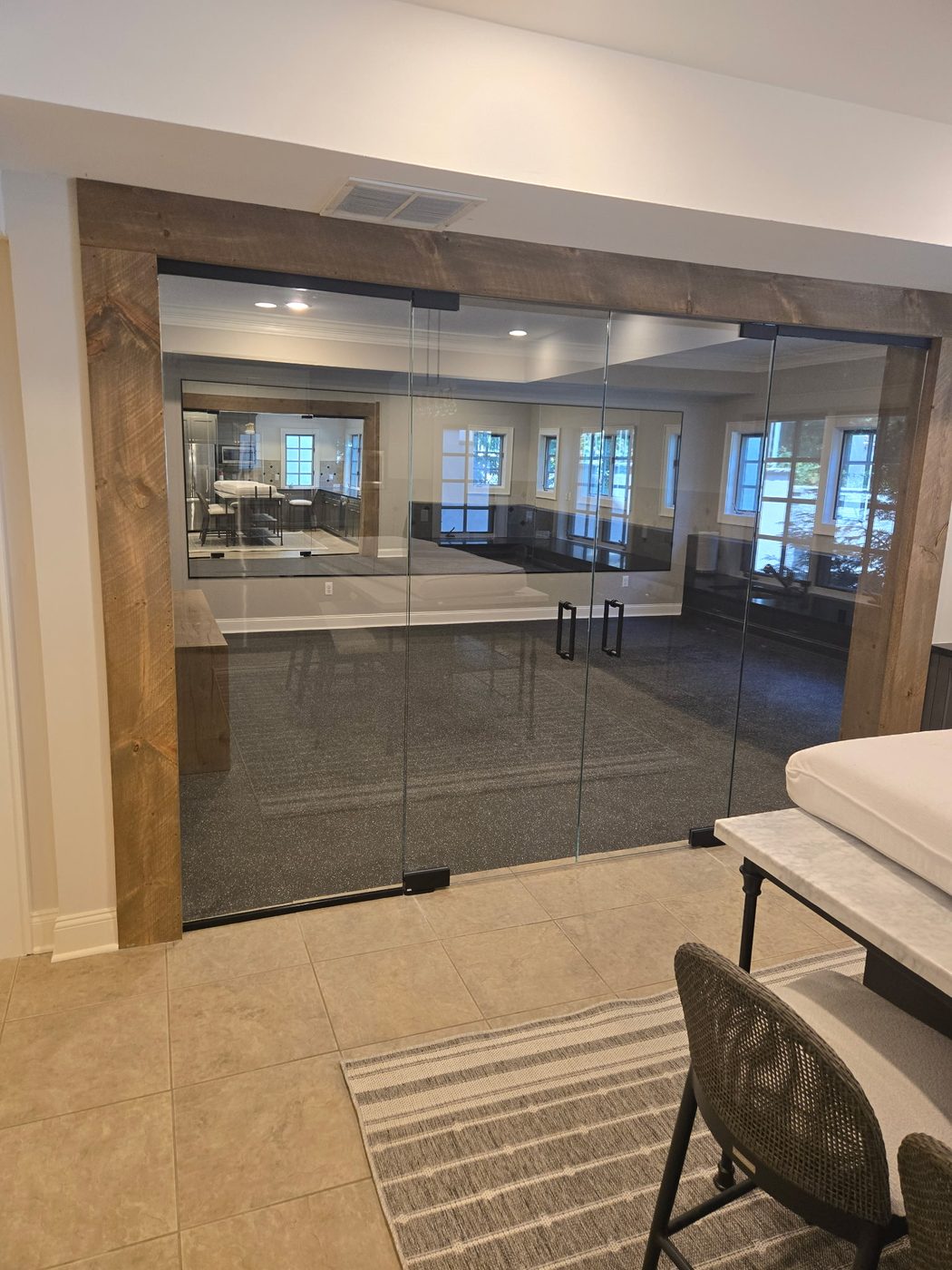
- Boutique retail frameless entry — 16-foot-wide, 10-foot-tall frameless all-glass entry with paired heavy doors, 1/2-inch tempered, hydraulic floor closers, polished stainless hardware. $45,000 – $75,000 installed.
The wide ranges within each pattern reflect glass spec, finish, access and timing. We quote line-by-line so you can see where the money is going and where there's room to trim.
Need a commercial storefront quote?
Send a few photos and approximate dimensions and we'll come back with a written quote in 1–2 business days. We work directly with general contractors, property managers and business owners across Bergen, Passaic, Hudson and Essex counties.
Request a Storefront QuoteCost ranges at a glance
For quick reference, here are the typical price points on commercial storefront work in North Jersey, summarized:
| Project type | Typical total |
|---|---|
| Single panel replacement (existing frames) | $650 – $2,200 |
| Door replacement only (single, framed aluminum) | $2,500 – $6,500 |
| Pair of doors with full hardware | $6,000 – $14,000 |
| Small retail front, like-for-like | $8,000 – $14,000 |
| Standard office front, IG low-E | $22,000 – $42,000 |
| Large retail / restaurant front | $35,000 – $80,000 |
| Boutique frameless entry | $45,000 – $75,000 |
| Class A lobby curtainwall | $80,000 – $200,000+ |
Insurance and claims
Most commercial property policies in NJ cover storefront damage from named perils — wind, fire, vehicle impact, vandalism, and in many cases accidental breakage. Deductibles on commercial glass claims typically run $500 to $2,500.
We work directly with insurance adjusters on storefront claims. The fastest claim path is: (1) photograph the damage before any cleanup, (2) call us for an emergency board-up, (3) we provide photos, written estimate and invoice the carrier requires, (4) permanent glass is ordered and installed once the claim is approved. Most businesses pay only the deductible at completion.
If you're dealing with active damage right now, see our guide on emergency storefront board-up and replacement for the timeline and what to do in the first hour.
Lead times
Standard lead times from order approval to install:
- Single-panel replacement, stock-spec tempered into existing frames: 3–7 business days.
- Framed aluminum storefront, stock-color, IG low-E: 3–4 weeks.
- Custom-color anodized framing or laminated glass package: 4–6 weeks.
- Frameless all-glass entry with heavy hardware: 5–8 weeks for fabrication, plus install scheduling.
- Emergency board-up for damaged glass: same-day in most cases — temporary plywood while permanent glass is on order.
Putting it together
A commercial storefront quote in NJ comes down to three things: the system you choose (framed vs frameless, single-pane vs IG, standard vs thermally broken), the hardware spec on the doors, and the access and timing logistics. Expect $75 to $225 per square foot installed for the glass-and-framing assembly, plus $2,500 to $7,500 per door for hardware packages, plus any line items for lift equipment, after-hours work and permits.
Send measurements, a photo or two of what's there now, and a sentence on what you want — like-for-like, modern upgrade, full reframe, or starting from scratch. We'll come back with a written line-item quote you can hand to your GC, your property manager, or your insurance adjuster. For trade and contractor pricing on multi-store rollouts or build-outs, see our contractor partners page.